
Fast-cure coatings
Polyaspartic Floor Coating in Grand Rapids, MI
Walk on it in hours and park in about a day, with a topcoat that resists sun and abrasion.
- Free on-site estimates with a moisture check
- Written, itemized quote before work starts
- Diamond grinding and crack repair before any coating
Less Downtime, More Working Season
Polyaspartic floor coating is a type of aliphatic polyurea, as HomeGuide describes it, and its main selling point is speed. Bob Vila's cost guide says a polyaspartic floor is usually walkable in three to four hours and ready for vehicles in about 24 hours, compared with roughly 12 hours to walk and three days to drive on for standard epoxy. For a family that needs the garage back quickly, or a business that cannot close for a week, that difference matters.
Where the speed helps in Grand Rapids
The coating season in West Michigan is not year-round for every product. Standard epoxy cures slowly when the slab is cold, and a detached garage in late fall can be too cold for it to cure properly. Many polyaspartic products are formulated to cure in cooler conditions than typical epoxy, which can stretch the season, though every product has its own minimum temperature listed on its data sheet. We check slab and air temperature before we schedule and heat the space if needed.
UV stability and color
Aromatic epoxies tend to amber, or turn yellowish, when exposed to sunlight. Aliphatic coatings like polyaspartic hold their color. That matters for garages with the door open on summer afternoons, sunrooms, covered porches and any space with big windows. A common approach is an epoxy base coat for build and bonding, with a polyaspartic topcoat for UV and abrasion resistance. Full polyaspartic systems are also used.
The tradeoff: it cures fast in the bucket too
The same speed that gets you back on the floor makes polyaspartic harder to install. It has a short working time once mixed, so it has to be applied in small batches, quickly and evenly. That is one reason it is not common in store kits. It also makes prep timing tighter: the floor has to be ground, repaired and vacuumed before mixing starts, because there is no time to fix things mid-coat.
Is polyaspartic always the better choice?
Not always. It usually costs more per square foot than epoxy. On a damp basement slab, the moisture problem has to be handled with the primer and prep no matter what topcoat goes on. And a thick epoxy base still has a place under heavy loads. We recommend polyaspartic when downtime, cold-weather installation or UV exposure make it worth the extra cost, and we explain the choice in the quote.
A typical one-day garage
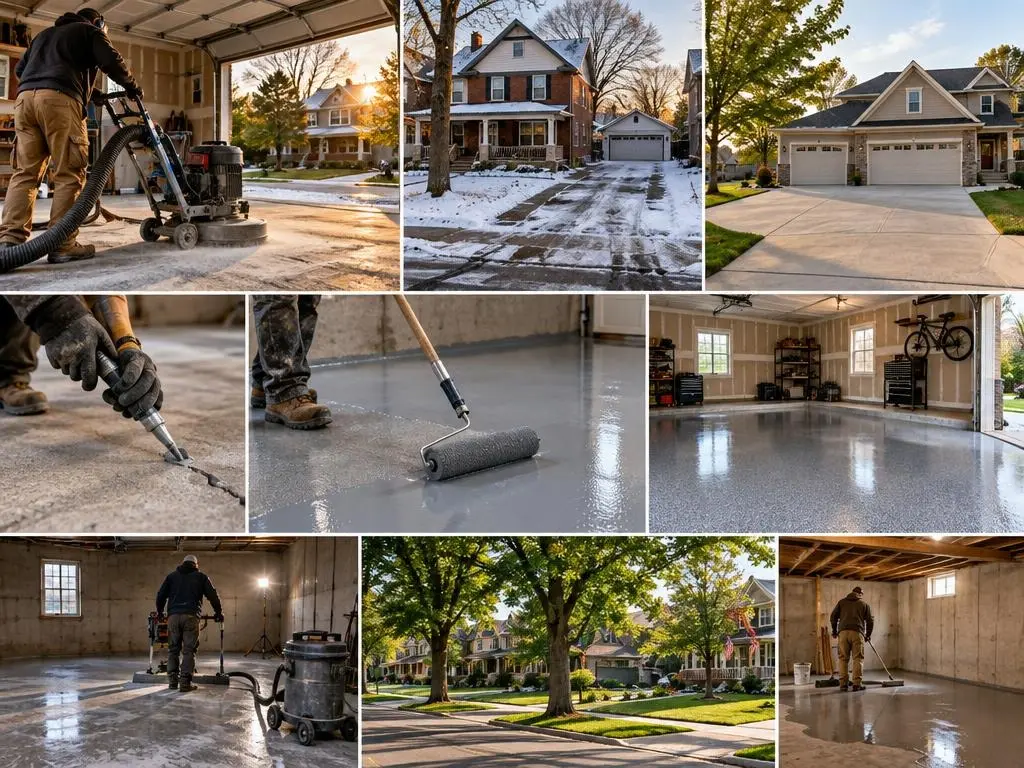
- Morning: diamond grind the floor, vacuum and fill cracks
- Midday: base coat, often with a full flake broadcast
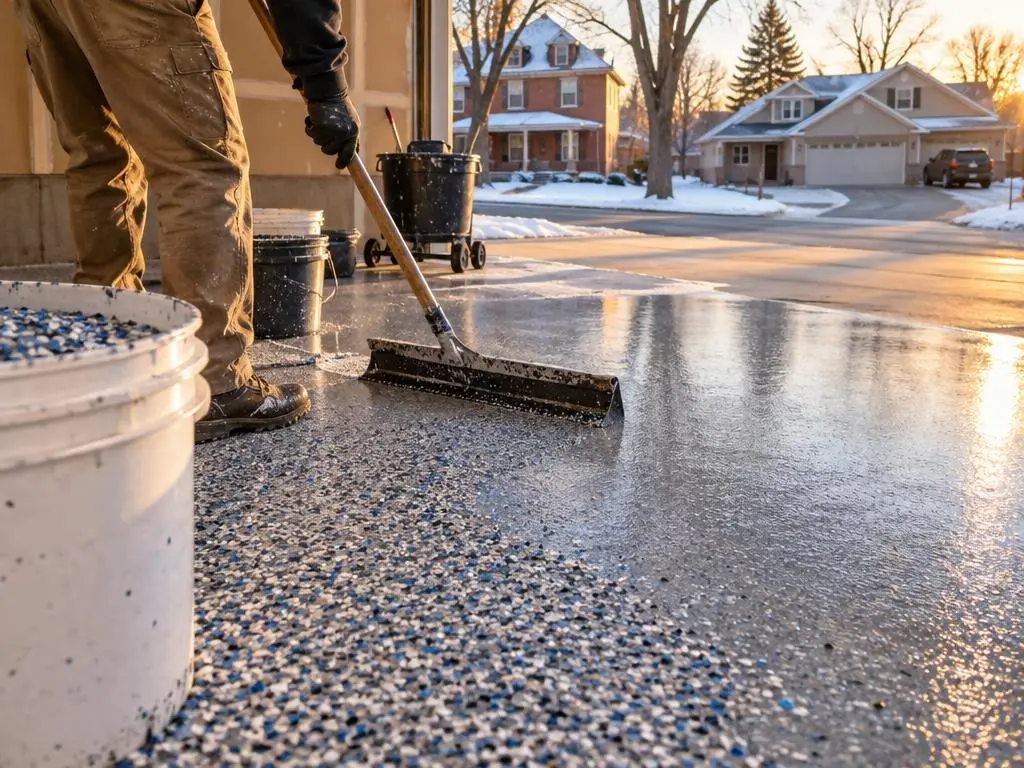
- Afternoon: scrape loose flakes and apply the clear polyaspartic topcoat
- Evening: light foot traffic once the topcoat has set, per the product sheet
- Next day or two: move items back and park, depending on temperature
Care and upkeep
Polyaspartic topcoats resist salt, oil and gasoline well, but sand and grit still scratch any finish. Sweep regularly, push winter meltwater out, and use a pH-neutral cleaner. Put felt pads or a mat under jack stands and kickstands.
What This Covers
Polyaspartic can be the whole system or the topcoat over an epoxy base.
Polyaspartic topcoat
A clear, UV-stable layer over an epoxy or flake base for abrasion and color stability.
Full polyaspartic system
Base and topcoat both polyaspartic for the fastest return to service.
Cold-season installs
Product and heating chosen for the slab temperature when a fall or winter install is needed.
One-day garage floors
Grind, repair, base, flake and topcoat completed in a single day where the floor allows it.
Typical Polyaspartic Floor Coating Costs
| Item | Published range |
|---|---|
| Per square foot (HomeGuide) | $5 to $12 |
| Per square foot (Bob Vila) | $4 to $9 |
| One-car garage (288 to 392 sq ft) | $1,400 to $4,700 |
| Two-car garage (400 to 576 sq ft) | $2,000 to $6,900 |
| Three-car garage (576 to 864 sq ft) | $2,900 to $10,400 |
| Moisture barrier, if needed | about $1 extra per sq ft |
National ranges from HomeGuide and Bob Vila. Local prices can differ, and repairs, old coatings, flake and moisture work change the total. Your written estimate is the price.
How It Works
1. Check slab and temperature
We look at moisture, cracks and slab temperature to choose products that will cure properly.
2. Prepare
Diamond grinding, vacuuming and repairs are finished before any coating is mixed.
3. Coat in small batches
Base and topcoat go down quickly and evenly within the product's short working time.
4. Return to use
Walk on it in hours and park in about a day, per the product sheet and conditions.
Polyaspartic Floor Coating Questions
Is polyaspartic better than epoxy for a garage?
It cures faster and holds its color in sunlight, which epoxy does not. Epoxy is usually cheaper and builds thickness well. Many garage systems use both: an epoxy base with a polyaspartic topcoat.
How long does a polyaspartic floor take to cure?
Bob Vila's guide says about 3 to 4 hours before foot traffic and about 24 hours before vehicles. HomeGuide lists a full cure at 24 to 48 hours. Cold slabs slow that down, so we give you times for your floor.
Can polyaspartic be installed in cold weather?
Many polyaspartic products are rated to cure at lower temperatures than standard epoxy, but each has a minimum. We measure slab temperature and may heat the space before installing in late fall or winter.
How long does a polyaspartic floor last?
HomeGuide lists polyaspartic coatings at about 10 to 20 or more years. Prep, traffic and how much salt and grit the floor sees all affect that.
Polyaspartic Floor Coating Service Areas
- Epoxy Flooring in Grand Rapids, MI
- Epoxy Flooring in Wyoming, MI
- Epoxy Flooring in Kentwood, MI
- Epoxy Flooring in Walker, MI
- Epoxy Flooring in Grandville, MI
- Epoxy Flooring in East Grand Rapids, MI
- Epoxy Flooring in Rockford, MI
- Epoxy Flooring in Cedar Springs, MI
- Epoxy Flooring in Lowell, MI
- Epoxy Flooring in Sparta, MI
- Epoxy Flooring in Comstock Park, MI
- Epoxy Flooring in Plainfield Township, MI
- Epoxy Flooring in Hudsonville, MI
- Epoxy Flooring in Jenison, MI
- Epoxy Flooring in Allendale, MI
- Epoxy Flooring in Coopersville, MI
- Epoxy Flooring in Zeeland, MI
- Epoxy Flooring in Holland, MI
- Epoxy Flooring in Byron Center, MI
- Epoxy Flooring in Caledonia, MI
- Epoxy Flooring in Gaines Township, MI
- Epoxy Flooring in Wayland, MI
- Epoxy Flooring in Grand Haven, MI
- Epoxy Flooring in Alpine Township, MI
- Epoxy Flooring in Ada Township, MI
- Epoxy Flooring in Cascade Township, MI
- Epoxy Flooring in Forest Hills, MI
- Epoxy Flooring in Greenville, MI
- Epoxy Flooring in Belding, MI
- Epoxy Flooring in Ionia, MI
Get a Polyaspartic Floor Coating Estimate
Free estimates for polyaspartic floors in Grand Rapids and West Michigan.